Frequently Asked Questions
Wanting to add new bins or signage? Have questions about what belongs where? Take a glance at these bin FAQ before reaching out to the Office of Sustainability with more questions:
*Buildings that are in scope with this document include the Moffitt Long medical center, Mount Zion medical center, Mission Bay medical center, the Ambulatory Care Center, and the Bayfront Medical Building.
1. Where should bins go?
Bins are better together!
- Centralized waste stations help to fundamentally change the way waste is being collected.
- Leave no bin behind: solo bins are much more likely to become contaminated!
- Separately colored bins with clear labeling and corresponding-colored liners help to keep materials clean and separate.
- It is imperative that the waste stations have a permanent location after implementation: allows employees to know exactly where to dispose of waste properly.
Best bins for your space:
- Break Rooms/Pantries: a trio of landfill/recycling/compost is best!
- Team-work areas: a duo of landfill/recycling is best!
- Restrooms: a duo of landfill/compost is best!
- Public areas: a duo of landfill/recycling, with a bottles and cans recycling lid is best!
 Break room waste station.
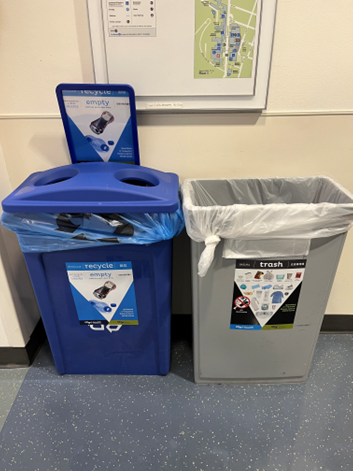 Public area waste station.
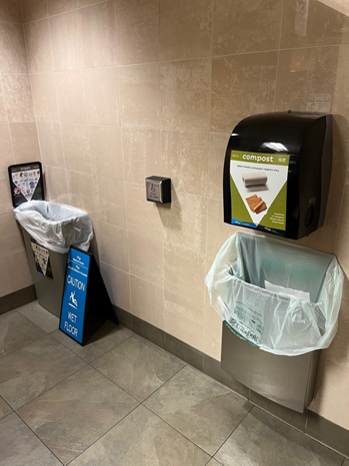 Restroom waste station.
But why is it not best to have a landfill, recycling, and compost bin at every location?
- The City of San Francisco has maximum allowable contamination rates for the landfill, recycling and compost streams.
- For landfill the maximum allowable contamination is 25%, for recycling it is 10%, and for compost it is just 5%.
- If contamination exceeds this rate, UCSF Health gets fined, and the entire recycling and compost bags will be disposed of in the landfill, hence why sorting properly is so important!
- By only placing bins where they are most needed and will be used correctly, we can reduce waste stream contamination.
2. Where should signs go?
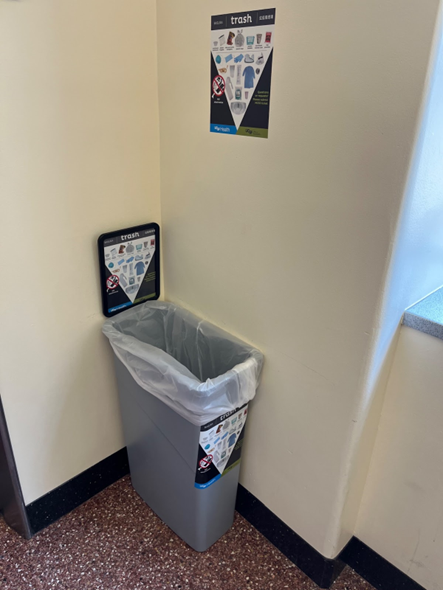 Example of wall signage, a sign holder, and signage on the bin.
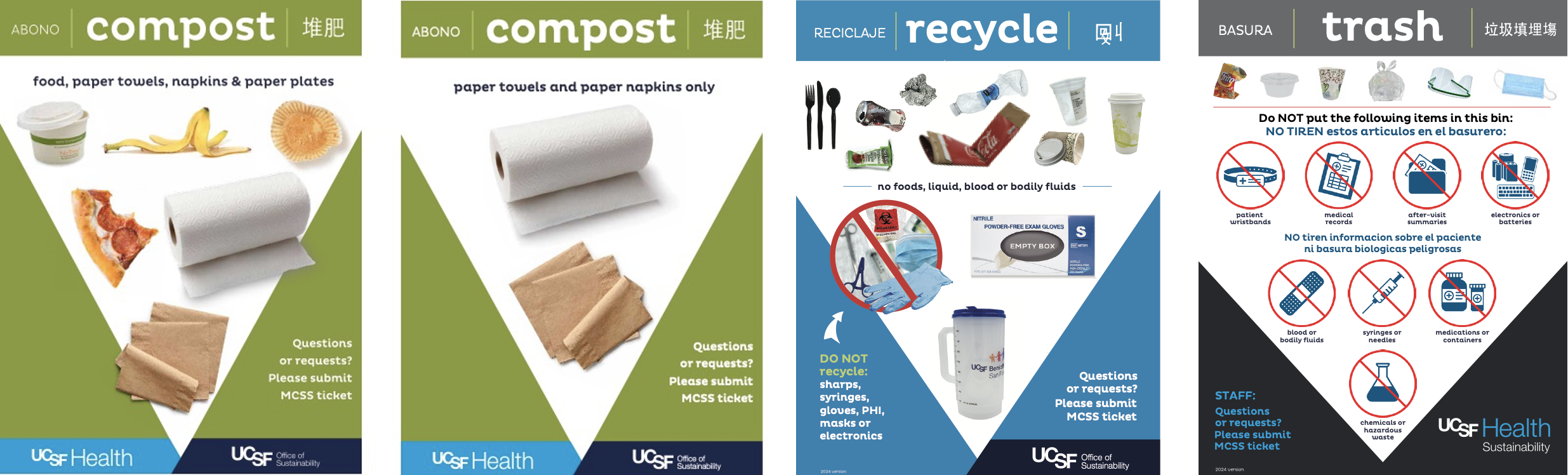 *Restroom compost signage has been simplified to reduce confusion and contamination
3. Why aren’t more bins better?
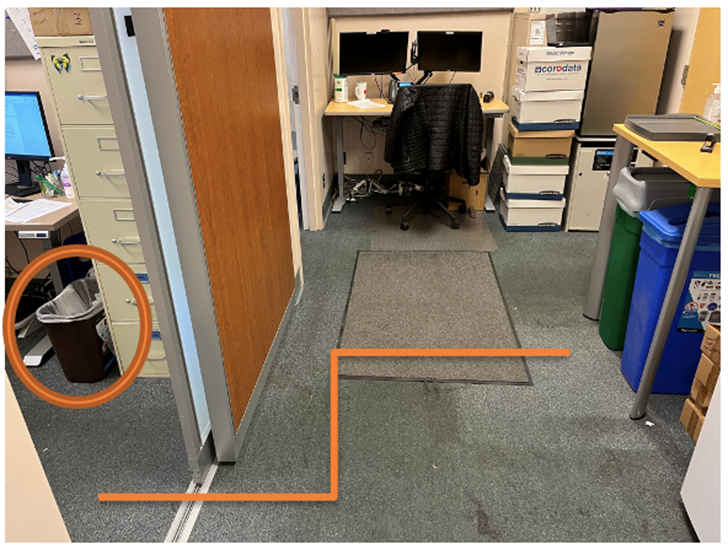 Example of a small deskside bin that should be removed. Instead, the employee should use the waste station.
4. What goes where?
Landfill
- Uncontaminated PPE including masks, gloves, and eye protection
- Plastic film/bags
- Snack wrappers
- Food soiled plastic containers
- Foil pouches
- Styrofoam
Recycling
- Cans
- Paper cups
- Clean Paper
- Cardboard
- Thick plastics
- Plastic bottles
- Utensils
- Plastic cups
- Coffee cup lids
- Plastic containers
Compost
- Food
- Paper towels
- Napkins
- Compostable containers
- Food contaminated paper products
- Muffin wrappers
- Paper plates
5. Why aren’t there compost or recycling bins in patient rooms?
6. What are hospitality’s contributions?
- Hospitality works very close with the Sustainability department by:
- Purchasing bins for the waste station programs
- Covering costs for auditing tools
- Collecting all waste
- Training all team members on the correct colored liners to use for each waste stream:
- Clear bags for landfill
- Blue bags for recycling
- Green compostable bags for compost
- If you notice the wrong color liners are being used, please reach out to healthsustainability@UCSF.edu
To request a waste sorting training, a waste bin placement walkthrough, waste sorting signage, or a waste audit, visit "Sustainability Services" in MCSS.
To request waste bins, see "Hospitality in MCSS"

Questions? Email healthsustainability@ucsf.edu
An overview of waste bin guidelines at UCSF Health