UCSF’s Commute Survey is conducted annually to monitor travel behavior of the UCSF community. The results help guide transportation planning decisions and track progress toward environmental targets.
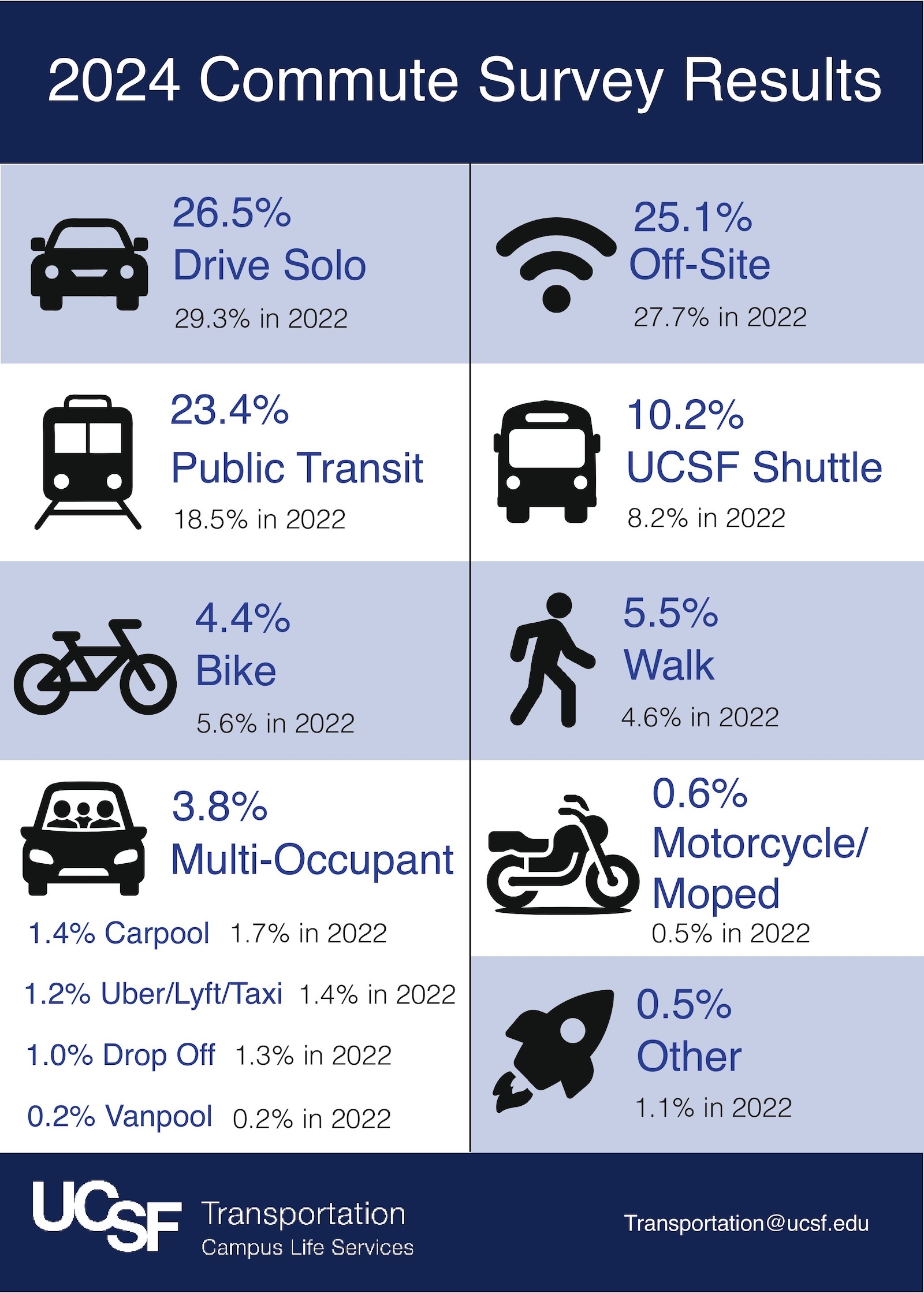
The latest survey, which was sent out in June, received responses from more than 7,500 UCSF staff, faculty, and learners. This accounts for 21% of the UCSF population. Results showed that even though the rate of remote work has gone down to 25.1% from 27.7% in 2022 (and from 48.4% at the height of the pandemic in 2020), the rate of commuters driving alone to work has not increased. Instead, as more people return to campus, they are choosing to take UCSF shuttles, public transit, and other more sustainable modes.
This year’s survey invited respondents to provide open-ended comments about how to improve their commute options. More than 4,000 responses were received, including suggestions for expanding shuttle service, exploring connections to transit hubs, adding vanpools or rideshare options, and strengthening bike infrastructure, among many others. The Transportation team is using these comments to explore ideas for implementation.
Driving Alone
The single occupancy vehicle (SOV) or “drive-alone” rate fell to 26.5% from 29.3% in 2022 despite an increase in the number of people coming to campus. A low drive-alone rate is positive because it means that UCSF has fewer cars on the road, producing less congestion and lowering carbon emissions. The UC Sustainable Practices Policy sets a goal for each UC to reduce its SOV rate by 10% from 2015 to 2025. UCSF’s 2025 goal is 28.8% or less, which was successfully met this year.
Public Transit and UCSF Shuttles
Use of public transit and UCSF shuttles dropped significantly during the pandemic, but ridership continues to trend back towards pre-pandemic rates. At the beginning of the pandemic, ridership dropped from 35.2% in 2019 to 6.9% in 2020. Every year since, ridership has been going back up. In 2024, it increased to 23.4% from 18.5% in 2022. Similarly, UCSF shuttle ridership grew to 10.2% from 8.2% in 2022, getting closer to pre-pandemic ridership rates of 11.6% in 2019.
For more information, including alternate commute options, please visit transportation.ucsf.edu.