This past January marked the one-year anniversary since the UCSF Ultra Low Temperature (ULT) Freezer Rebate Program was launched campus-wide. The program originally started as a pilot that offered a way to bridge the gap for researchers to replace their old freezers, some of which have been operational for decades.
Since the program's launch, over 160 labs have signed up, and 133 freezers have already been disposed of. This has resulted in $174,198.09 in utility cost savings—a figure that Sustainability Officer Elizabeth Lin says will continue to grow as more units are replaced.
The program started when Dean Shehu, Senior Category Manager for Supply Chain Management, was asked by Vice Chancellor of Research, Harold R. Collard, MD, MS to investigate alternative options for cold storage.
Shehu himself was a lab manager at UCSF for five years, then as a product line manager in industry, prior to pivoting to supply chain management and was able to leverage his experiences to consider how to approach solutions for the research community.
Shehu started with a mass inventory of UCSF’s 1,200 ultra-low freezers. Around the same time, then Sustainability Director Gail Lee asked Shehu to look into a new type of Energy Star ultra-low freezers.
With the support of UCSF Professor, Epidemiology & Biostatistics, Mi-Ok Kim, PhD, MS, MA, Shehu was able to use available literature to build a model that could accurately predict freezer rate of degradation, HVAC impact, and overall energy costs over time. He then compared this with the potential savings of the newer Energy Star models, which each consumed as much energy as a three-bedroom house.
“The potential savings in electricity and costs were pretty staggering. It was about 2.3 million, if every negative 80 on campus were to be converted to an Energy Star version,” Shehu said.
Shehu shared his findings with the Research Advisory Board, capturing the attention of different stakeholders, including B. Joseph Guglielmo, then Dean of the School of Pharmacy who had the undeniable sense that UCSF was on the brink of a game-changing breakthrough.
“It's been great that the work that I did early on was validated by the results of the pilot. It's an honor to then get funding to expand it campus-wide,” Shehu said.
Shehu, with backing from Guglielmo, PharmD, the Office of Sustainability, and Executive Vice Chancellor and Provost Dan Lowenstein, MD, launched a pilot that successfully replaced 43 of UCSF’s most vulnerable ULT freezers with EnergyStar models.
“It’s important to note that the researchers own these freezers, and our program is designed to be an attractive option for labs that may have faced financial challenges in upgrading their equipment,” Lin said.
The Office of Sustainability has been working closely with the logistics teams who coordinate at every stage of the process, from installation to proper disposal of older units. The office is on track to have 186 disposals with a total of 1,067,769 kWh of energy reduction, which would translate to $245,593.08 in total utility cost savings.
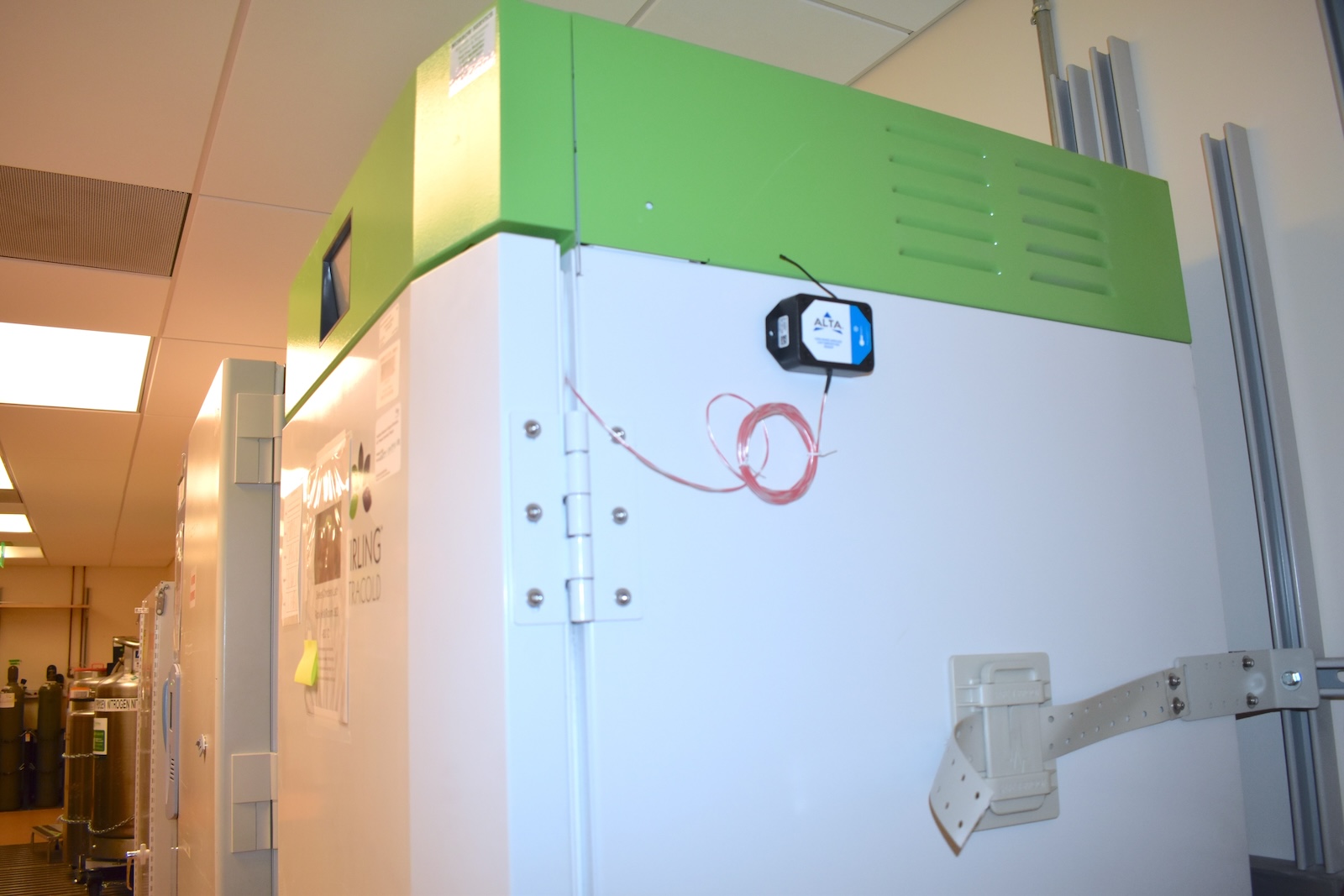 Energy Star Sterling freezers like this one are included in the ULT Freezer Rebate Program
Newer Energy Star models not only reduce energy costs but also protect invaluable research samples.
“These freezers run 24/7, holding invaluable research samples. A significant risk involves older models that may not restart if unplugged, not keep temperature, or just fail randomly outright, which would jeopardize those samples.” Lin said.
Mary Anne Hallacy, Program Manager for Facilities Research Support Services and a Facilities Manager, explained that more Energy Star units can be connected to the standby power at once, optimizing backup power sources and keeping samples safe in the event of an outage.
“UCSF is one of the top biomedical research universities in the country, if not the world, and the contents of these freezers are priceless. The Freezer Rebate Program and the free remote freezer monitoring program for -80s are incredibly valuable tools for supporting world-class research,” Hallacy said.
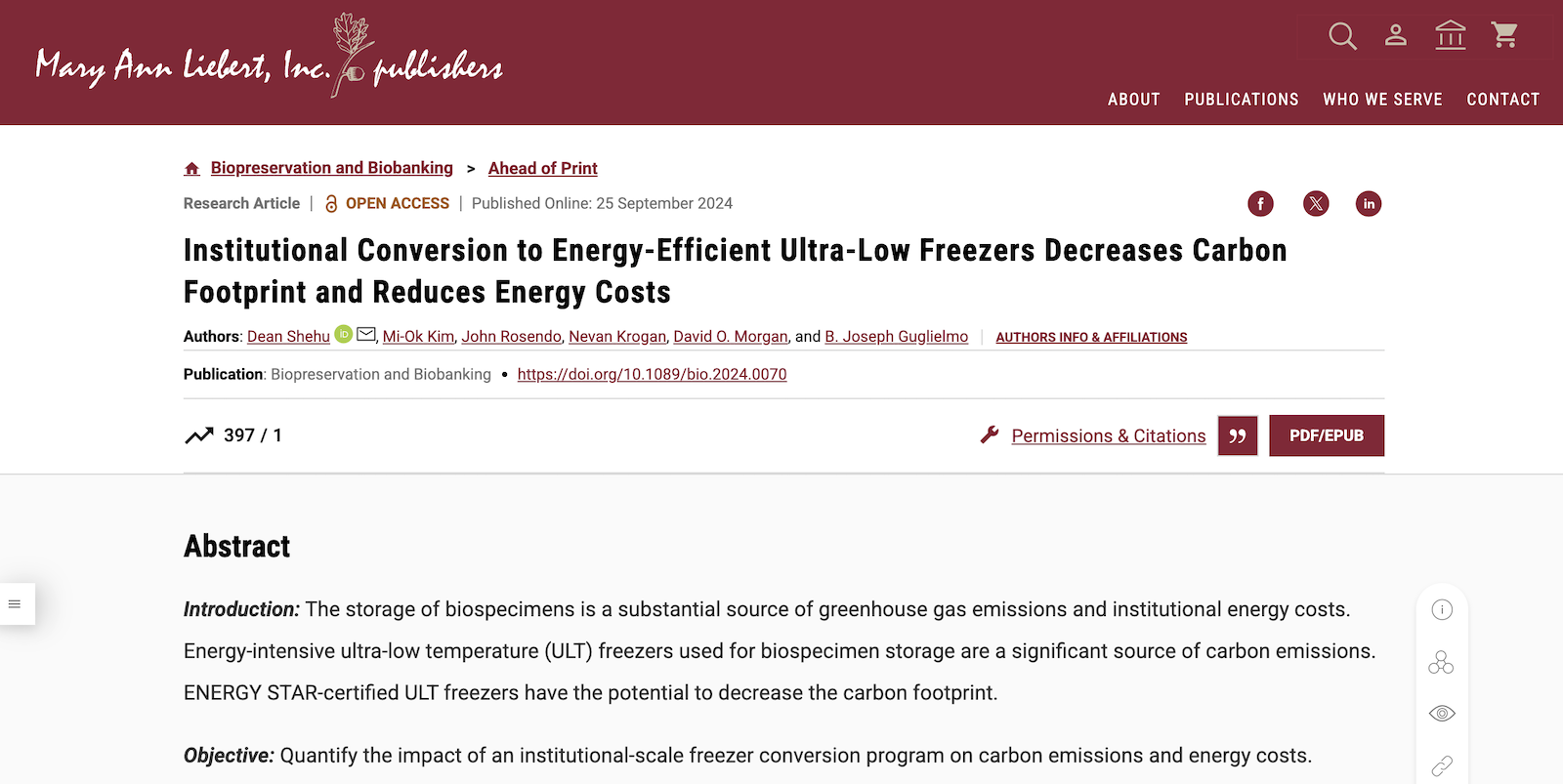 Shehu and his colleagues published a paper on their methods to make replacing energy-inefficient ULT freezers logistically possible.
UCSF-Wide and Beyond
The success of the pilot program prompted Guglielmo, who retired in 2022, to encourage Dean Shehu to publish the findings in a research journal so that other institutions could replicate the pilot program.
“The impact upon the carbon footprint, energy consumption and overall cost was highly significant. However, results such as ours had never been published in a peer-reviewed journal. The goal was to disseminate our results in a way that would maximally result in a ripple effect within and beyond UCSF’s borders, ”Guglielmo said.
Together, Shehu and Guglielmo put in months of work on compiling the paper, with Shehu putting in hours after work and on weekends, posted up at a local coffee shop near where his daughters had volleyball or soccer practices.
“There was a point at which I was trudging away writing this paper, revising it, cleaning it up. I wasn't really satisfied, and I kept rewriting sections of it in my off hours so I could stay on top of my normal duties, but not let my work stuff interrupt my focused time on the paper,” Shehu said, “What kept me going was knowing that people are going to be interested in this. These algorithms are going to help. People who do this project in other institutions are not going to have to start from scratch because we've done the work. That’s what was gratifying.”
Guglielmo continued advising Shehu well into his retirement, diligently reading and providing notes on the paper in progress. When asked what motivated him to continue this project after his career at UCSF, Guglielmo shared his concern for future generations.
“My wife and I have four daughters and are grateful to be grandparents many times over. Many of our grandchildren are acutely aware of the reality and unequivocal impact of global warming. They ask, ‘Is there anything that can be done? Does anybody care? Is it up to our generation to figure out this mess?’ Some lie awake at night worrying about the current and future impact of global warming. Frankly, the reactions of these children reaffirmed for me the critical importance to aggressively address this problem at UCSF."
Shortly after, the ULT Freezer Rebate Program began to receive national and international attention. In 2023, the program was honored with the California Focus on Efficiency Award for Innovative practices that have improved operational performance, services, and outcomes for California Public Higher Education.
Last November, the program also received the national award for applied sustainability best practices: creativity, innovation, and cross-functional collaboration from the University Logistics Supply Chain Association (ULSCA).
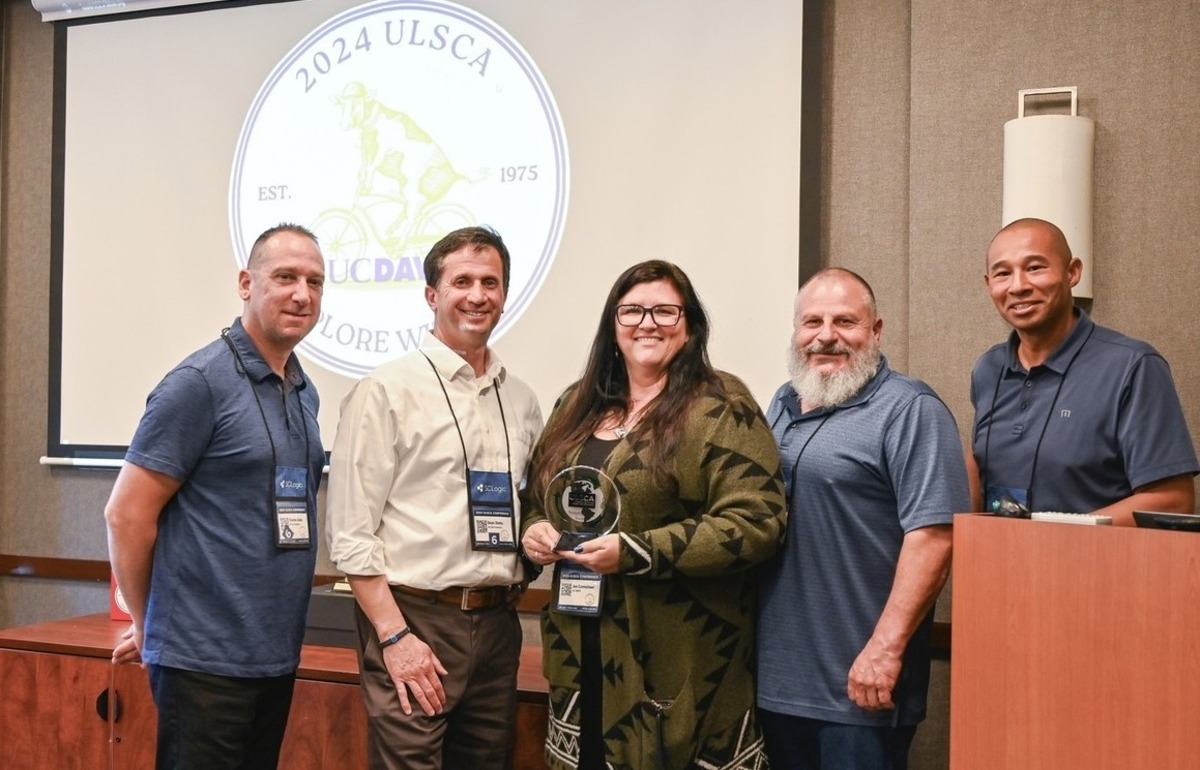 Pictured left to right: Charles Sabia, Dean Sheri, Jen Carmichael, David Grubbe, Mel Maxwell at at the ULSCA conference in San Diego.
The project recently garnered international recognition, with Shehu being invited to present findings at the International Society for Biological and Environmental Repositories (ISBER) conference in Montreal, Canada, in May.
“Regarding our models to predict and forecast energy use and costs: It's a lesson that you never know when you're going to be the first one to do something. I just realized, okay, there's something here. People do need to know this, and I think I’m the only person who has really delved deep into this topic right now. So, I have to create something on my own,” Shehu said, “And next thing you know, engineers and sustainability people in industry and other academic institutions are contacting me, ‘Oh, that's really cool. Let us have the paper when you're done'.”
Guglielmo says the success of this project has made him feel optimistic about the future.
“This project showed the value of a well-purposed team. Successful completion of any research project requires the unique contributions of each team member. The freezer project was unequivocally a team effort with each member providing their expertise toward the completion of a highly successful project. In a way, it was classic UCSF; collaborative and collegial.”