The healthcare sector accounts for 8.5% of all greenhouse gas emissions in the United States. Most of those emissions come from operating room activities, with a study at the University of Minnesota Medical Center finding 51% of total emissions were from the Operating Room (OR).
UC Health is dedicated to reducing its environmental impact and, therefore, the impact its operations have on vulnerable populations. To address its contribution to climate change, the UC Office of the President developed the Transforming UC Health Systems to Reduce the Impact of Climate on Vulnerable Populations project. This project includes an objective to reduce greenhouse gas emissions by transitioning to a portable system for nitrous oxide.
Anesthetic gas waste offers a significant potential for reducing emissions, since up to 95% of anesthetic gas used is not metabolized by patients. Nitrous Oxide (N2O) is a common anesthetic gas used for pain relief and sedation, and has a global warming potential that is 265 times stronger than that of carbon dioxide over 100 years.
Studies have found that central piped N2O systems leak large amounts of the gas straight into the atmosphere before reaching patients. Deactivating the central piped nitrous oxide system and transitioning to portable cylinders is an effective strategy to reduce the wasted anesthetic gas while maintaining quality patient care.
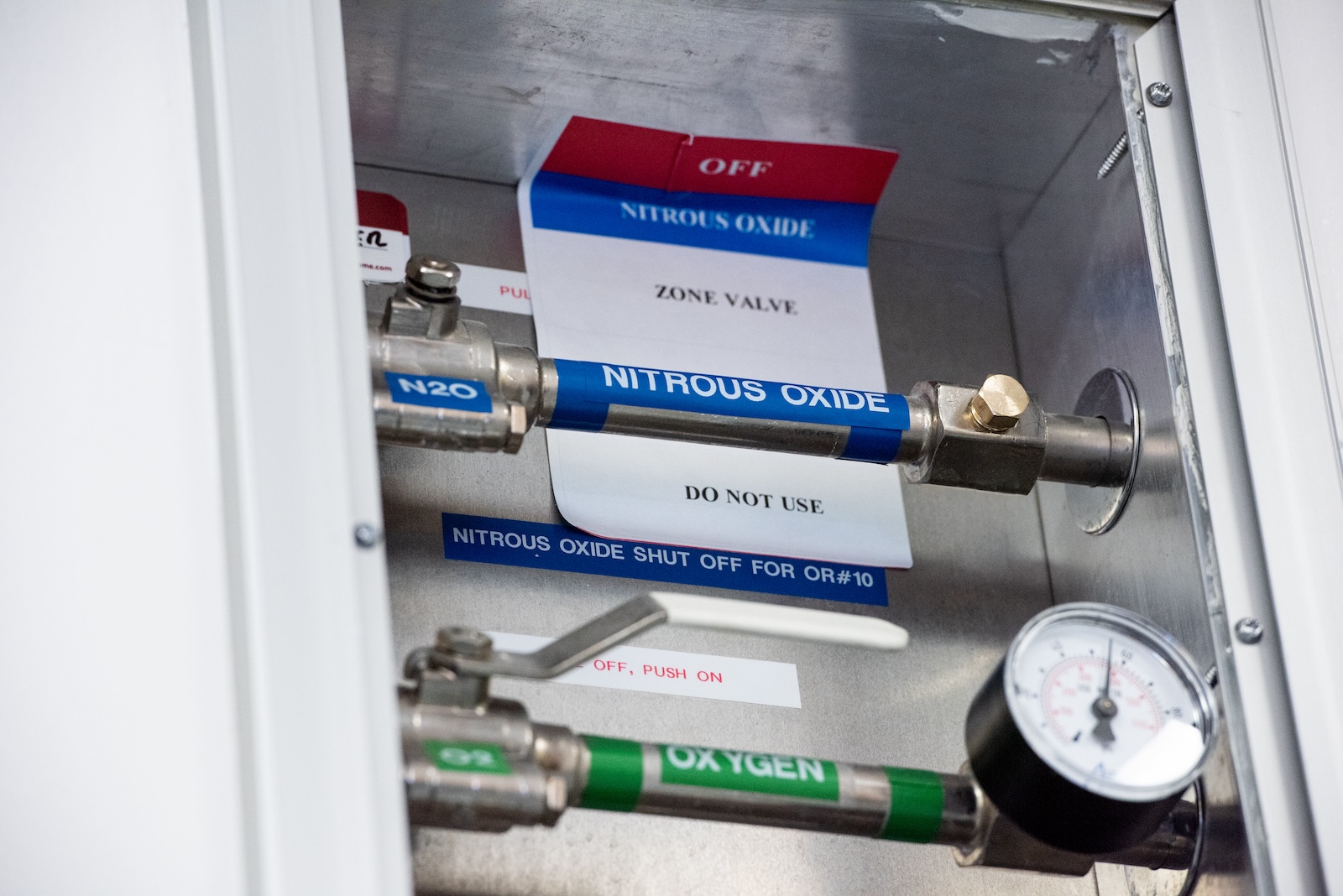
In 2024, each UC Health center, including UCSF Health, UC Davis Health, UC Irvine Health, UC Los Angeles Health, and UC San Diego Health, worked to deactivate its central nitrous piping and transition to a portable cylinder system. You can learn more about the transition process at UCSF Health by reading the UCSF Health System's Sustainability Journey: Pioneering New Practices to Minimize Nitrous Oxide Emissions newsletter story.
To document and share the work completed, a Transitioning to a Portable System for Nitrous Oxide Delivery toolkit was developed, along with a webinar, “Collaborative Approaches to Deactivating Piped Nitrous Oxide."
The toolkit and webinar are designed to make information about the transition process more accessible and can be utilized by health systems as a framework for reducing their N2O emissions. To learn more about this important work, you can watch the webinar recording and read the newly published Transitioning to a Portable System for Nitrous Oxide Delivery toolkit.