FREQUENTLY ASKED QUESTIONS
1. Why Do I Need a Project Manager?
A project manager plays a crucial role as your primary point of contact, ensuring the smooth and coordinated execution of your project from start to finish.
Project managers are responsible for:
- Keeping you informed on progress throughout the project lifecycle.
- Managing key phases: scoping, planning, construction, and project closeout.
- Coordinating qualified design professionals, such as architects and engineers.
- Securing project approvals from university departments, including:
- Building Permit Services
- Designated Fire Marshal
- Campus Small Project Design Review Committee
- Environmental Health & Safety (EH&S), and others.
- Overseeing the appropriate construction bidding process and selecting contractors.
- Managing contractors and supervising project inspections.
- Providing follow-up services after occupancy, as needed.
A project manager ensures that your project stays on track, meets its goals, and adheres to university requirements with minimal disruptions.
2. Why Do I Need a Permit?
Permits are essential for construction projects for several key reasons:
- Safety: Permits ensure that construction complies with building codes, safety regulations, and zoning ordinances. This protects the safety of construction workers and future occupants of the building.
- Structural Integrity: Construction plans are reviewed by building officials and engineers to confirm the building's structural integrity, preventing accidents and structural failures.
- Code Compliance: Building codes exist to guarantee that buildings meet specific standards for electrical, plumbing, fire safety, and more. Permits verify that projects adhere to these standards.
- Quality Control: The permit process includes inspections at various stages of construction. These inspections maintain quality and ensure work is performed according to code.
By securing the proper permits, you can be confident that your project is safe, compliant, and built to last.
3. Why Does My Project Have to Go Out to Bid?
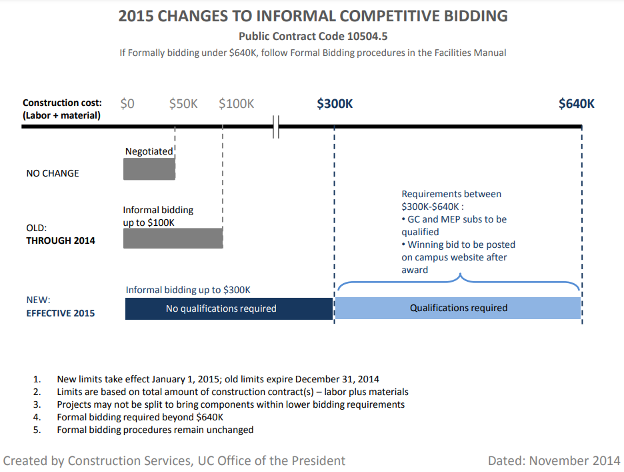
Competitive bidding is required by the public contracting code and is determined by specific thresholds to ensure fairness, transparency, and value for public funds.
- Negotiated Contracting: Used when the construction cost of a project does not exceed $50,000. In this case, the contract sum is negotiated directly between the University and the contractor.
- Informal Competitive Bidding: We solicit bids from three or more qualified contractors who can perform the required work. The contract is awarded to the lowest responsible bidder submitting a responsive bid. If none of the bids meet our criteria, all bids may be rejected.
- Formal Competitive Bidding: A rigorous process that adheres to applicable laws and regulations. This typically involves issuing requests for proposals (RFPs) or utilizing other authorized competitive selection methods to procure goods or services.
Competitive bidding ensures that projects achieve the best value while maintaining compliance with legal requirements.
Knowledge base
WHAT IS TRIAGE?
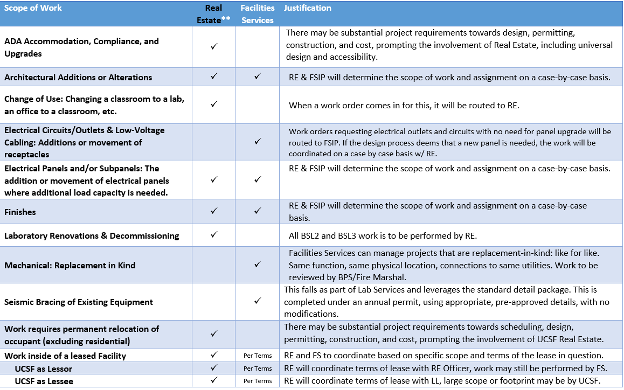
Facilities Services and Real Estate have collaborated to develop a comprehensive triage document that clarifies whether work falls within the Real Estate or Facilities domain. To enhance the efficiency of our work order handling process and ensure optimal allocation of resources, our Real Estate - Facilities Services Triage team convenes regularly every Monday.
Key Resources:
ANNUAL PERMIT
To reduce costs and streamline repetitive small projects, UCSF Facilities Services has partnered with Building Permit Services (BPS) to create standardized sets of pre-engineered details.
Key Features:
- Pre-Approval: These details are pre-approved and utilize pre-specified components for installation, simplifying the process for projects such as seismic restraints and small MEP (Mechanical, Electrical, and Plumbing) work.
- Efficiency: By standardizing design elements, the initiative reduces the need for customized design efforts, saving time and resources.
For a full list of project types covered under this partnership, visit Annual Permit Bulletin
Important Note:
Projects falling outside the scope of these pre-approved details will require additional design and permitting.
AUTHORITIES HAVING JURISDICTION (AHJ)
Authorities Having Jurisdiction (AHJ) are entities responsible for enforcing building codes, fire codes, and other regulations to ensure compliance within a specific jurisdiction. For UCSF Tenant Improvement (TI) projects, collaboration with these entities is critical to maintaining compliance, safety, and operational excellence.
Key AHJs for UCSF TI Projects:
| Building Permit Services | Primary AHJ for all UCSF Campus and Health construction projects. |
| EH&S (Environmental Health and Safety) | Provides expertise and resources to ensure a safe workplace, safe work practices, and environmental preservation across UCSF. |
| Designated Campus Fire Marshal | Oversees fire safety compliance for campus facilities and projects. |
| Campus Small Project Design Review Committee | Reviews and approves modifications to building exteriors and common spaces. |
| UCOP Facilities Manual | Outlines University of California policies, procedures, and guidelines for facilities, including planning, design, construction, and facilities management. The manual reflects Regents’ policies, state and federal laws, and UC dispute resolutions. |
| UCSF Signage Standards Manual | Provides comprehensive design standards to ensure cohesive, high-quality design and construction across all UCSF sites. The standards focus on cost-effectiveness, flexibility, efficiency, and durability, supporting design excellence. |
By working closely with these AHJs, UCSF ensures that projects meet required standards, comply with regulations, and maintain the highest levels of safety and design quality.
