As temperatures across the Bay Area recently spiked above 110-degrees and cities across the region recorded their highest temperatures ever, UCSF Campus Energy Manager Ben Levie and his team (shown above) were taking actions to keep electricity running on campus.
On the hot days, the grid was stressed. The California Independent System Operator had to conduct rolling blackouts in parts of the state. In response to the emergency, UCSF was asked to reduce load and run standby emergency generators. At Parnassus, the central plant put extra power back on the grid to help out.
“We had one day where the heat caused real issues,” Levie said. The PG&E service to Genentech Hall, Byers Hall & Rutter failed (likely due to high heat load) and the Mission Bay Childcare Center temporarily lost power and closed early. Levie said the UCSF Parnassus Campus experienced no heat-related outages but some of the older buildings without air conditioning were too hot.
Thanks to proactive measures taken by Levie, Senior Chief Engineer Ronny Melo and his team, and Parnassus Central Utility Plant Chief Engineering, David Burrill, UCSF reduced the usage and increased the generation of power onsite. The electricity remained on at UCSF despite record temperatures.
Proactive measures included sending daily flex alerts to the campus community describing how and when they could reduce energy. By working together, UCSF was able to reduce energy use and avoid rolling blackouts.
“We responded by ‘resetting’ the temperatures in open spaces and offices at 5pm instead of the normal 9 to 10pm,” Levie said. “We also ran back-up generators to reduce our dependence on the power grid. The use of emergency diesel generators was authorized by the governor for the Flex Alert in order to avoid large, rolling blackouts. We kept the PCUP (Parnassus Central Utility Plant) generation at higher levels than the campus required in order to export energy back to the grid. Our efforts allowed us to avoid buying some very expensive power during the peak hours and getting paid by the PG&E for demand response. Barak Albeg had presciently enrolled our emergency diesel generators in the Emergency Load Reduction Program last year, which pays UCSF for our reduction from grid power.”
Associate Vice Chancellor of Facilities Services, Jon Giacomi, praised the facilities staff for their work during the heat wave and the energy team for increasing energy efficiency at UCSF. “They have done a great job and are continuing to build resiliency in our system,” he said. “One of our greatest concerns is that we expect these alerts to become more common. We encourage every researcher at UCSF to make 100 percent sure they have proper alarming on their -80 freezers so that we can be sure to preserve UCSF’s precious research samples in the event of a prolonged outage.”
Levie and his team have taken preventative steps by developing and implementing building improvements to increase energy efficiency. “We are making labs and buildings smarter and more efficient – controlling ventilation rates to the levels needed for safety along with installing high-efficiency lighting with occupancy and daylight controls,” Levie said.
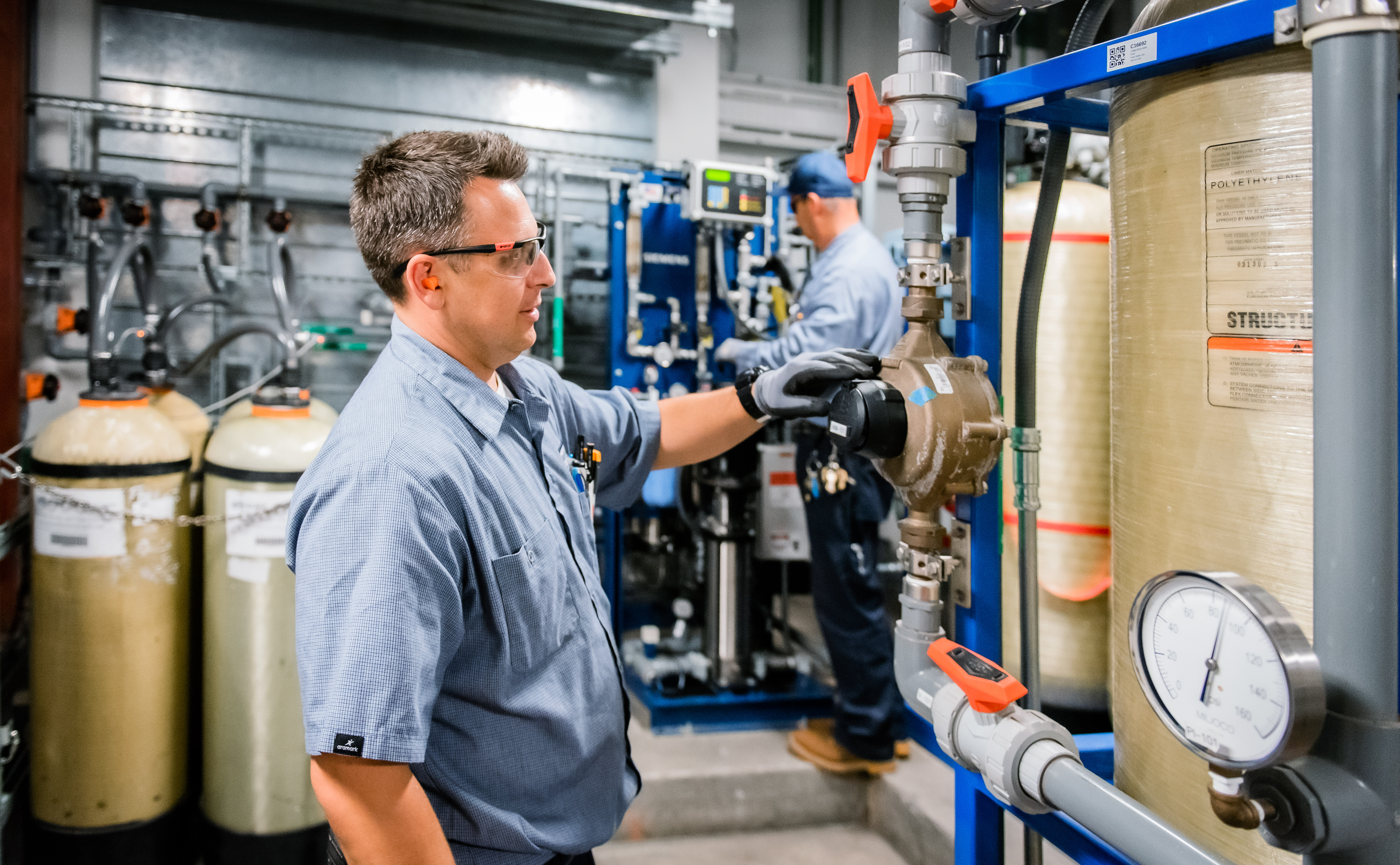 Marko Hrga (close) and Ricardo Martin adjust machinery to save energy.
The team is planning future projects to recover heat from chillers and use that heat rather than rejecting it. This will concurrently reduce evaporation of water from cooling towers to save water consumption.
Moving forward, Levie said the campus community can play a role in reducing energy use at UCSF. “There are the common-sense measures such as consolidating freezers, buying energy efficient equipment and turning off the lights,” he said. “But we also need the support of campus to improve overall energy efficiency in our buildings.”
This means understanding there will be disruptions as buildings undergo energy retrofits, infrastructure changes, and construction of high-performance buildings. “For instance, we are going to reduce energy use by nearly 50 percent at the Mt. Zion Cancer Research Center in the next year, but it means researchers need to be agile and move out of labs undergoing duct work renovations.”
Levie said new labs and buildings at UCSF are being built smarter and more efficient. “We are controlling ventilation rates to the levels needed for safety, installing high-efficiency lighting with occupancy and daylight controls.”
New buildings, and retrofitting older buildings, will help reduce energy use across campus. “The offices and open spaces can be controlled for occupancy and respond to electric grid issues and events such as heat waves when we have the right set of controls, lights, motor drives, and sensors,” he said. “This is coming to a building near you!”