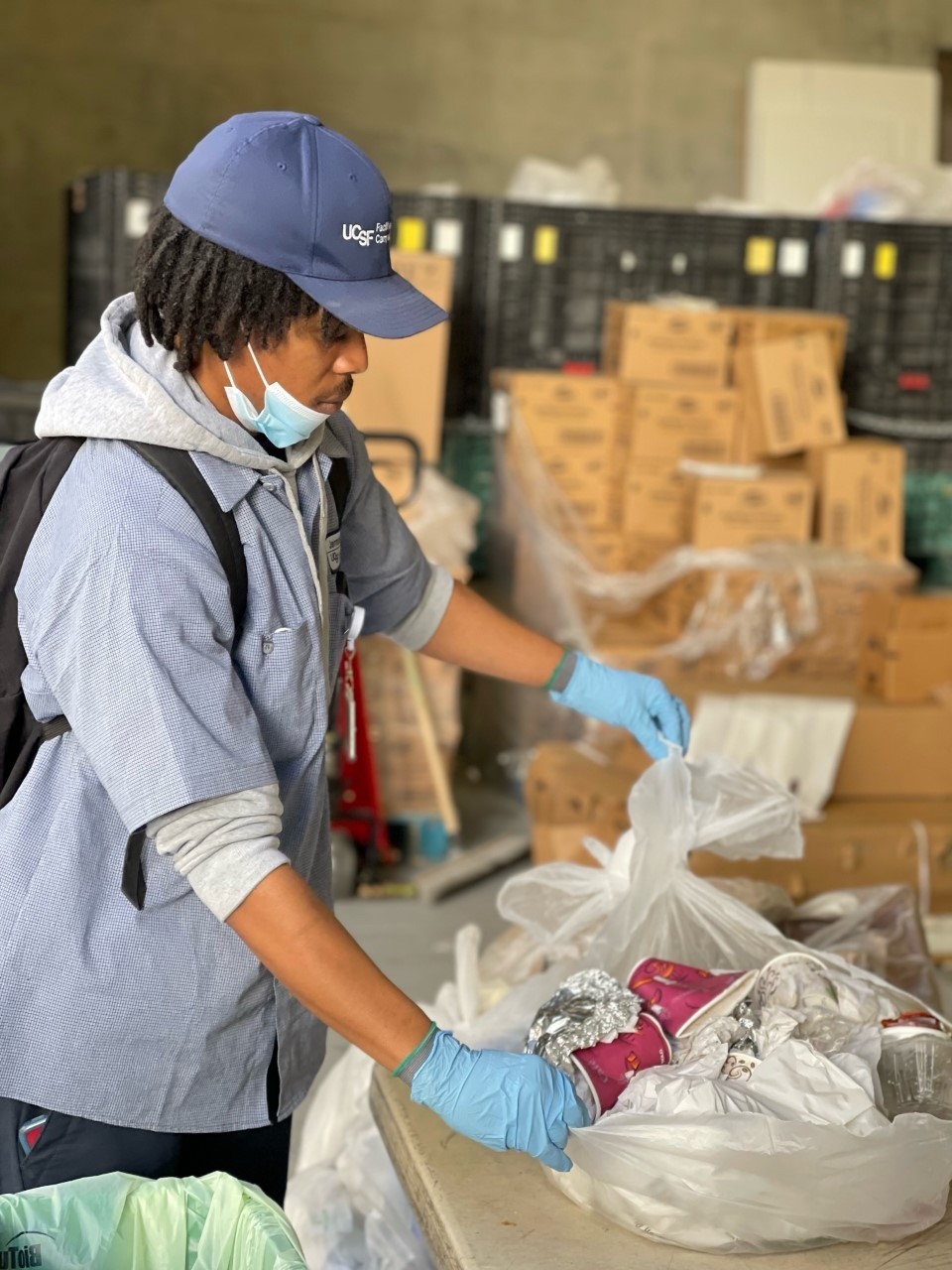
On a recent morning at Mission Bay, recycling sorters Jermaine Snelgro (photographed, below), Ben Keim (above) and Glenn Sabillo were busy pulling apart garbage bags as the first line of defense in UCSF’s continuous efforts to make sure recyclable and compostable materials aren’t shipped to the landfill.
“When the guys sort the garbage bags, they pull out items that are supposed to be recyclable like water bottles, plastic food trays, and aluminum cans,” said UCSF Recycling & Waste Reduction Lead, Jon Asuncion. “They pull out compostable items like napkins, paper towels, and food soiled paper which we do not want to see go into our landfill.”
The City and County of San Francisco has identified UCSF as a Large Refuse Generator (LRG) because it generates more than 40 cubic yards of waste per week. The university has 13 LRG properties (10 campus and three Health). In 2019, San Francisco passed a law to ensure that LRGs were properly separating refuse from recycling and composting.
That means Asuncion and his team are sorting through campus waste daily to make sure materials that can be recycled or composted do not end up in the landfill and that unacceptable materials such as e-waste and hazardous waste are not mixed in with the trash.
As part of the city’s ordinance, Recology randomly audits LRG’s at least once a year, but the UCSF Recycling and Waste Reduction team does its best to maintain compliance by regularly performing its own audits and correcting any issues before Recology arrives. “The info we collect from our audits helps us craft education opportunities and identify key stakeholders who may need to correct some disposal habits,” said Recycling and Waste Reduction Program Manager, Daniel Chau.
To help identify contamination in the university’s waste stream, Chau and his team use a waste auditing platform called Zabble Zero.
“Our team members have the app installed on their mobile devices and snap photos and note what contamination is found in a bag or bin,” he said. The data from campus buildings is then aggregated onto a dashboard that Chau monitors. “I have a number of different graphs, bar charts, plot points, word clouds and other visuals that show contamination by building and date ranges.”
At a glance, Zabble Zero shows Chau and his team a building-by-building view with color-coded boxes for different types of waste contamination such as food soiled paper, plastic bottles, hazardous waste, Styrofoam and more. A red bar indicates that the waste type found is above acceptable levels while a green bar shows it is lower.
 “The Zabble Platform is fairly revolutionary and they’ve received EPA grants for their process,” Chau said. “The system is a smart learning platform. Our staff takes pictures and the app can auto recognize what is in each bag and notes how full the bag or bin is as well. It is really advanced in terms of auditing platforms and pretty simple to use. We were also a very early adopters of their technology so we get a discounted price,” Chau said.
By city mandate, UCSF’s trash destined for the landfill must not have more than 25 percent of compostable material; recycling can have no more than 10 percent of non-recyclable materials; and compost can have no more than five percent of non-compostable material.
“We perform daily trash audits to comply with city mandates and to understand how to craft educational strategies for buildings that may not be meeting the goals,” said Chau.
While Chau and his team are continuously monitoring the university’s waste stream, that does not abdicate the campus community from their duty of properly recycling and composting. “We still rely on the UCSF community to properly dispose of their waste so we can comply with the city mandates.”
UCSF Sustainability Director, Gail Lee, said one of the most important waste-related actions the UCSF community can take is to compost correctly. “This will help reduce methane gas, a potent greenhouse gas,” she said.