Last month, the UC San Francisco Facilities Services team announced the formation of a new 14-person recycling team. The team, comprised of transfers from within custodial services, will be dedicated to interior waste management. Previously, these and other cleaning duties fell under the responsibility of the custodial team.
The Assistant Director of the Recycling and Waste Reduction Program, Daniel Chau, initiated the formation of this team, utilizing a key finding from the vendor Core America, which calculated that the cumulative time 200 custodians spent on waste sorting was the equivalent of 14 full-time positions.
Now, instead of custodial teams collecting internal waste and recycling teams auditing the waste stream with targeted sorting at the building level, this work will be delegated to one team.
“We saw this as an opportunity to make some changes. None of the UCs have this in effect right now. So, we're one of the first of our kind to look at this. We thought, ‘Okay, could we just have that all work within one flow of one program?’” Chau said.
Chau says the move to unify waste processing efforts under the recycling team will allow for more streamlined communications, real-time audits, and targeted feedback.
“Having centralized waste management will help Facilities better understand what areas need to be improved and where educational resources can help prevent waste contamination and the related fines that occur when waste is not sorted correctly,” Chau said.
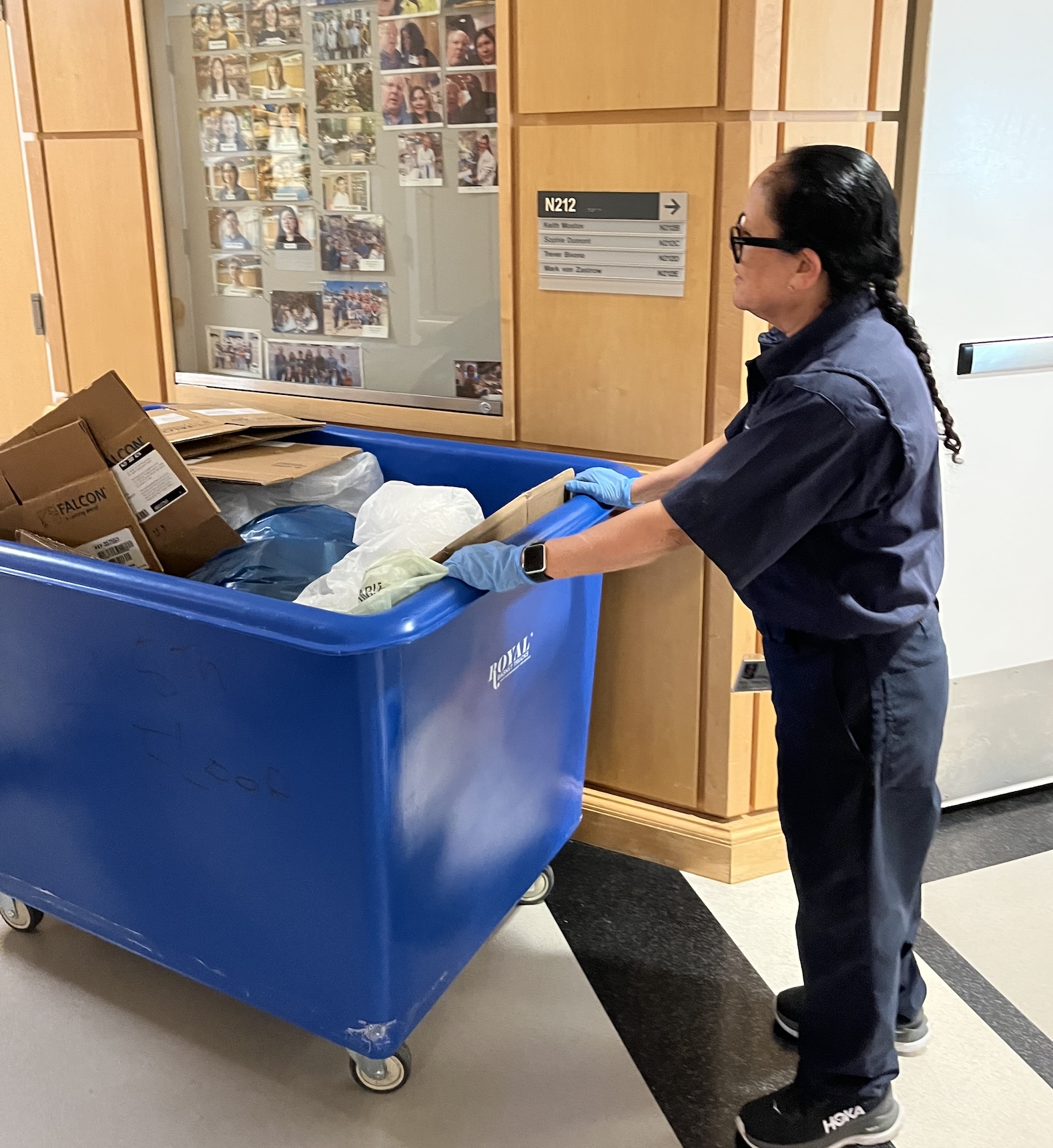 Maria (Isabel) Romo De Flores is one of the members of the newly formed team dedicated to interior waste management.
Improper Disposal Has a Price
The move is also anticipated to help UCSF save money by mitigating the fines received due to waste contamination or improper disposal.
“Higher contamination leads to higher fines…that cost is up to a thousand dollars a day per location. There are some very steep financial penalties for that. Even if we're not talking about sustainability from a fiscal perspective, it's costing us money,” Chau said, "Anything we can do to correct and fix the contamination will help us save money."
The Assistant Supervisor of the Recycling Program, Ashley Hui, is hopeful that this shift will help staff build relationships with and learn from their designated waste management experts.
“We believe that since these custodians are focused on just trash, they can spend more time doing so with their increased presence. If the staff, faculty, or anybody they're servicing has any questions, they can feel free to reach out and be like, ‘Hey, can you tell me where I should put this?’ I think that the outreach or education aspect is really at the forefront where the waste is being discarded.”
One of the ways this team will help save the university money is that the recycling team will now be better able to pinpoint where contamination is coming from.
“The custodians within the recycling team will also help conduct waste audits from the waste bins in the offices and labs. This will help the program craft more targeted education and outreach to specific users or departments where disposal habits would need to change,” Chau said.
These 'on-the-spot' audits will be documented through the Zabble app, and data collected through this process will then help Facilities Services zero in on where more support is needed to address the contamination and break bad habits.
“In terms of accountability, I think it also serves as a good example for other people to know that, hey? Things are being looked at...if it's coming from a specific floor or suite, we're getting that info,” Hui said.
Education is Key
Ultimately, Chau says, it’s not about blame but finding better ways to educate the community.
“I don't think anyone's purposely trying to contaminate or trying to do the wrong thing. With this change we're making, our education can be a little bit more targeted instead of us sending generic messages out to the campus.” Chau said.
It will also give custodians back the time they would spend collecting waste, allowing them to focus their energy on other high-priority projects.
“The custodial team can now spend more time on cleaning and providing further services. That means that they may have taken on another floor to do deep cleaning, or they're doing extra bathrooms to make sure we provide a cleaner environment because they're not having to worry about waste and taking it down to the dock and coming back up,” Chau said.
How UCSF processes waste impacts the entire waste and recycling system, and by extension, the environment.
“Everything that you do here has a snowball effect. That material [you are throwing away] still needs to go somewhere, and it's going to either go down the right path or the wrong path,” Chau said.
*Cover photo features members of the newly formed recycling waste reduction team (from left to right): Rosa (Marlen) Amador Bonilla, Maria Sanchez de Covarrubias, and Glendy Gallardo.