The year was 1994. Mary Anne Hallacy hopped on a local bus from her home in the Mission and headed to Golden Gate Park for her first AIDS Walk in San Francisco.
Hallacy heard of the AIDS Walk in San Francisco but had never been. When she showed up at Golden Gate Park that morning, she didn’t know what to expect.
“When you get off and you walk over there, you can't believe this giant sea of people. And one of the first things you see is the giant UCSF tent right at the entrance. I remember thinking, ‘Oh, one day I'll be on the UCSF team.’”
Hallacy has gone on to walk every year since that day in 1994, logging an impressive mileage of 180 miles -- the equivalent of walking from the Mission Bay campus to the edge of Reno, Nevada.
“I lived near the Castro, and I saw people who were sick. I knew there was no cure and that the treatments were uncertain. There was a lot of fear, misinformation, and sadness. I was dealing with my own sadness due to someone close to me being diagnosed, and I felt like the best way to deal with that was to unite and to support people. I wanted to channel my sadness and my fear into something bigger than myself.”
True to her word, Hallacy joined UCSF Facilities Services in late 2019. But COVID caused the 2020 and 2021 walks to be cancelled, so the event was held virtually for two years. Once 2022 came, she was ready to walk on the UCSF Campus Life Services team.
“The most important part about the AIDS Walk is community. When you get there, the only thing people care about is supporting people with HIV and AIDS or the organizations that support them. You see people from every kind of background, every age group, people in drag, people with strollers…it’s for everyone,” Hallacy said.
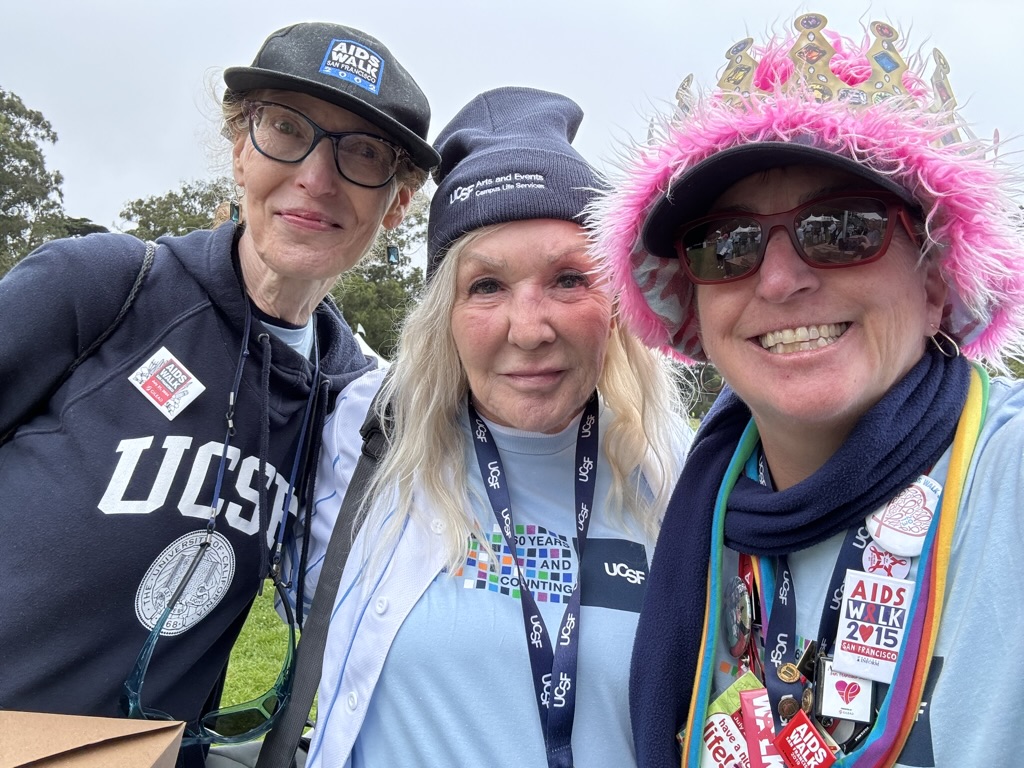 Mary Anne Hallacy walks with colleagues JC Saunders-Keurjian and Jennifer Dowd at the AIDS Walk. Photo courtesy of Jennifer Dowd.
UCSF – at the Forefront of HIV/AIDS Research Since 1987
When she started fundraising for the AIDS Walk, Hallacy could not have conceived of the immense progress that would take place in just 30 years. Much of this research has come from labs at UCSF run by researchers Hallacy knows personally in her capacity as a Program Manager for Facilities-Research Support Services.
“UCSF has been right there from the beginning. People were so afraid of how it was going to work for treating people with this communicable disease, and I think there was a tremendous amount of fear. When UCSF set up Ward 86 at ZSFG, they defined a model that was such a supportive model that it became a national model.”
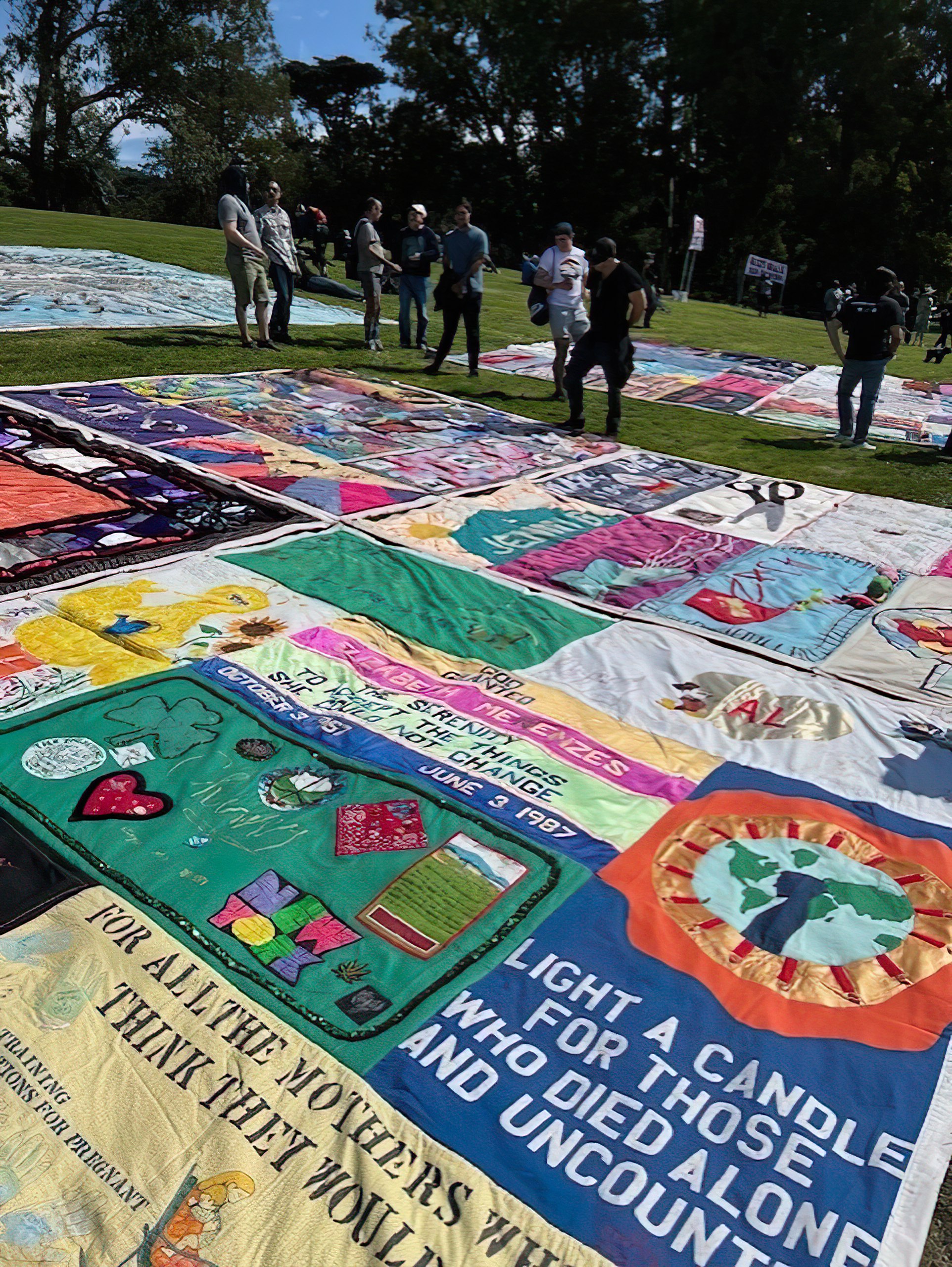 AIDS Memorial Quilt on display at the AIDS Walk.
Hallacy sees protecting research as an essential component to the well-being of a society.
“Health is a stabilizing factor. When you take away people's access to health and resources, you destabilize that community. And when you destabilize communities, not only do you impact the health, but you also impact the politics and community.”
Last year, the UCSF contingent raised over $100,000 at the AIDS Walk. Of that amount, a reported 70% went directly back to HIV/AIDS programs at UCSF.
Part of what motivates Hallacy to continue as Facilities team lead for the CLS team is that she doesn’t want UCSF to lose the progress it’s made.
“Given the current political climate and the tremendous impact on research and patient care and what that's felt like for UCSF, for our programs, and for our community, I think more than ever, we need people to show up and be part of the solution.”
For Hallacy, the answer is simple.
“Just sign up, lace up, and show up, and just go for a walk in the park with people you work with and know that what you're doing is supporting something bigger than yourself. And nobody can take that away from you.”
And for those who are new, Hallacy says there’s always a spot by her side.
“I love walking with people who haven't walked before. I think sometimes people think, ‘what is it going to be like? I don't know anybody.’ I would say that for anybody who's a first-time walker, if you don't have someone to walk with, you can walk with me.”
There’s still time to register by visiting the AIDS Walk website. CLS walkers who donate a minimum of $25-50 will receive a free UCSF t-shirt, breakfast, a post-walk lunch, and swag giveaways.